STEM Learning Company
Company
Shop By Category
T&Cs
Shop Online
  • Free standard delivery across Australia on orders of $100 or more
  • STEM kits, robotics, electronics and maker sets in one place
  • All prices include GST
  • Customer support 7 days a week

Pixel Art Coding Challenge | Screen-Free Coding Game | Maths Pixel Puzzle Set

Order your Pixel Art Coding Challenge Set

$85.99
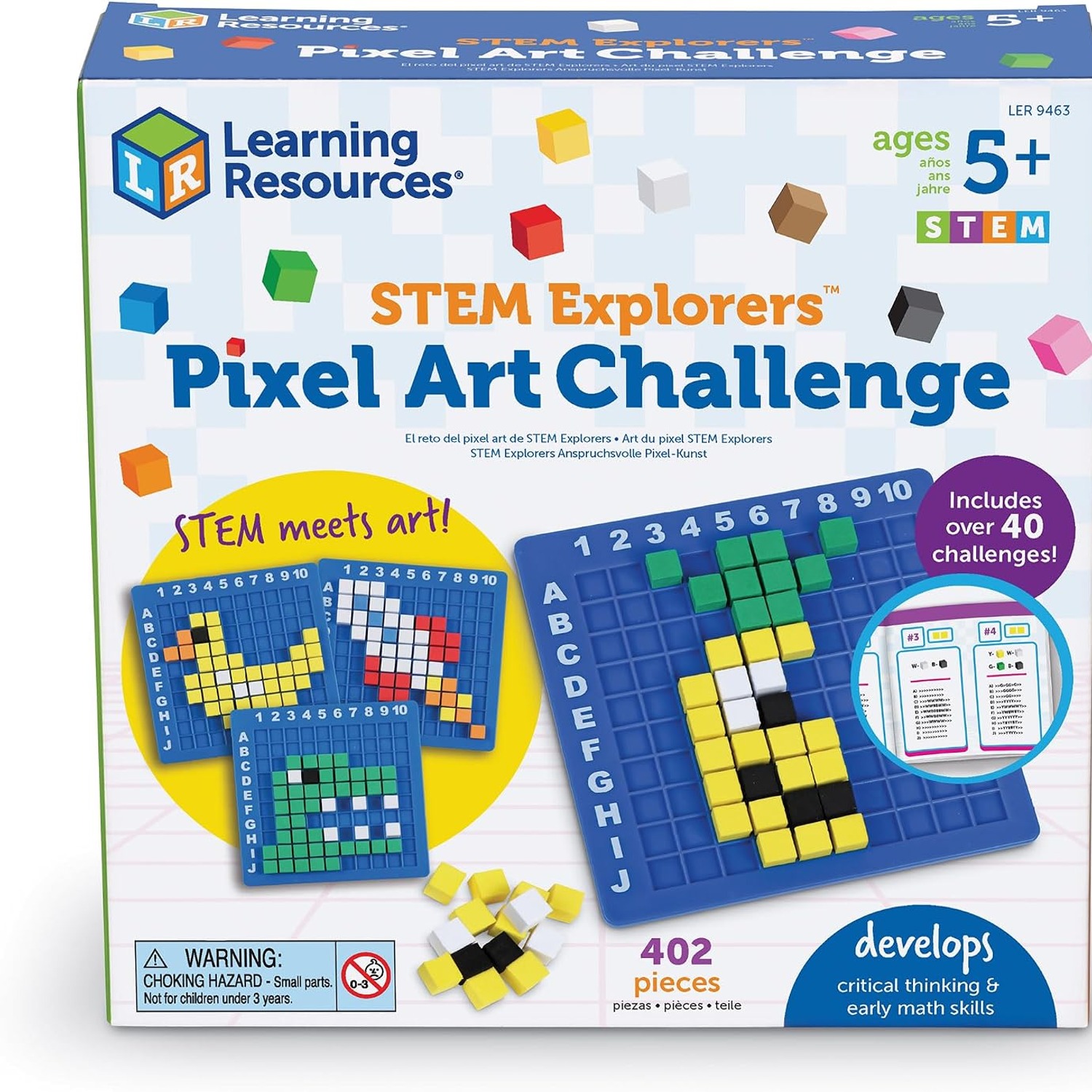
  • 500 Pixel Cubes
  • No Screens Needed
  • Challenge Cards Included
  • Four Display Bases
  • Children read a challenge card, work out where each coloured cube belongs, and watch an 8-bit style picture appear square by square.

Price: $85.99

  • Handling: 2 business days. Delivery: 7 business days by tracked courier after dispatch.
  • Free delivery across Australia on orders $100+, otherwise a flat $27.50
  • Pay by card or PayPal, handled by the payment provider
  • 15-day change-of-mind returns and exchanges. Conditions and return postage apply. Australian Consumer Law rights are unaffected. Full returns policy

Explore other kits

Product specifications
BrandLearning Resources
Set NameSTEM Explorers Pixel Art Challenge
Included Components500 pixel cubes, challenge cards, 4 interlocking display bases
Recommended Age5 to 8 years
Educational ObjectiveSTEM
BatteriesNot required
Operation ModeManual
Assembly RequiredNo
UsageIndoor
ColourMulticolor
MaterialPlastic
Item Dimensions20.3 x 20.3 x 6.4 cm
Item Weight0.26 kg
Weight0.26 kg
Shipping & returns

Orders dispatch from Australia. Standard delivery costs AUD $27.50 below a goods subtotal after discounts of AUD $100 and is free at AUD $100 or more. Prices include GST. Allow 2 business days handling plus 7 business days in transit: an estimated 9 business days in total. Business days are Monday to Friday, excluding public holidays; handling starts on the next business day after ordering. Carrier disruptions may extend these estimates. Express delivery is not offered.

Request a change-of-mind return or exchange within 15 calendar days after delivery. Items must be new and unused, in their original packaging, with proof of purchase. You pay tracked return postage to our Norwest NSW return address. There are no restocking, handling or cancellation fees. Original delivery charges are not refunded for change-of-mind returns. Australian Consumer Law rights are unaffected.

Refunds are processed within 24 to 48 hours after receipt of the returned item, subject to the return assessment; payment-provider processing can take longer.

If it arrives faulty, damaged or not as described, we put it right at no cost to you under the Australian Consumer Law's consumer guarantees, return postage included.

Shipping details · Refunds and returns

Explore Pixel Art Coding Challenge Set

This STEM Explorers set turns maths and coding practice into something kids actually want to sit down and do. Check the selected product and supplied contents before ordering.
What is in the box: pixel cubes in 10 colours, a 10 x 10 grid board and the challenge booklet.
Challenge types: match and build, colour by number, coordinates and simple coding.
A child copying a picture from the booklet onto the grid, cube by cube.

30 questions about Pixel Art Coding Challenge Set

What exactly is the Pixel Art Coding Challenge?

It is a screen-free STEM activity set from Learning Resources. Children solve maths and coding style problems from challenge cards and place small coloured cubes onto a base grid to form a picture. The finished result looks like retro 8-bit video game art.

What comes in the box?

The set includes 500 pixel cubes, challenge cards and four interlocking display bases. There is nothing else to buy to get started. No batteries or assembly are needed.

What age is this set for?

Learning Resources recommends ages five to eight years. Younger children in that range may want help reading the first few cards. Older ones usually move on to inventing their own designs.

Is this really a coding toy if there is no computer?

Yes, in the sense that it teaches the thinking behind code. Children follow ordered instructions, read coordinates and check their output against an expected result. That is the same logic a programmer uses, just with cubes instead of a keyboard.

Does it need batteries or an app?

No. The set is listed as manual operation with no batteries required, and there is no app component. It works straight out of the box.

How big is the set?

The item measures 20.3 x 20.3 x 6.4 cm and weighs about 0.26 kg. The individual cube size is not specified in this record. The four bases interlock, so the build area can be larger than one base alone.

How many challenge cards are included?

The set includes challenge cards, but the exact count is not specified in this record. The cards cover a range of different pictures and difficulty levels. Children can also create their own designs once they have worked through the pack.

What is the set made from?

The listed material is plastic. Specific plastic grade and any certifications are not stated in this record. Wipe the pieces clean with a damp cloth rather than putting them through a dishwasher.

Is it suitable for a child who finds maths hard?

Often yes, because the maths is wrapped inside a picture rather than a page of sums. A wrong placement shows up as a wrong colour in the image, so correcting it feels like fixing a drawing. Many parents looking for the best maths puzzle for kids choose formats like this for exactly that reason.

Can two children play together?

They can. One child can read the card aloud while the other places cubes, then swap. With four bases, two children can also work on separate pictures side by side.

Is this good for classrooms?

It suits a STEM rotation or a quiet corner activity well, since it needs no power and no setup. Teachers often use it as one station among several. If you are hunting for the best classroom stem activity that packs away into a single box, this format works.

Does it help with fine motor skills?

Picking up and placing small cubes takes a steady pinch grip and careful aim. That builds hand control alongside the maths. It is a common reason this style of set is picked as a best fine motor skills toy for school-aged children.

Can my child make their own pictures?

Yes, and most do fairly quickly. Once the card designs are done, children can sketch a grid on paper, colour it in and copy it across in cubes. That free-build stage is usually where the set gets the most hours.

Is it safe for a toddler sibling?

No. The cubes are small and should be kept away from children under three. Play on a table rather than the floor if a younger sibling is around, and pack the pieces into a lidded container afterwards.

How long does one picture take?

It depends on the design and the child. A simple build can take ten to fifteen minutes, while a larger multi-base picture might stretch across an afternoon. Many kids do two or three in a sitting.

Which currency is the price in?

Prices on this Australian store are in Australian dollars (AUD).

Is GST included?

Yes. Displayed Australian prices include GST.

How much is standard delivery?

Standard delivery is AUD $27.50 below a goods subtotal after discounts of AUD $100, and free at AUD $100 or more.

Where do Australian orders dispatch from?

Orders from this store dispatch from Australia for delivery across Australia.

How long should delivery take?

Allow 2 business days handling plus 7 business days in transit, an estimated 9 business days total. Handling starts on the next business day after ordering. Public holidays and carrier disruptions may extend this estimate.

Is express delivery available?

No. Express delivery is not offered on this store.

How can I pay?

Card payments are processed by Stripe. PayPal is also available at checkout.

Can I collect an order or visit a showroom?

This is an online store with delivery. Showroom visits and order collection are not offered.

How can I ask a question before ordering?

Email theteam@stemlearning.net.au or call 0495 092 753. Include the product name and the detail you need checked.

How do I track a dispatched parcel?

Use the Track Your Parcel page and the tracking details provided for your order. Contact the team if you need help finding them.

Can I return an unused item if I change my mind?

Request a change-of-mind return or exchange within 15 calendar days after delivery. Items must be new and unused, in their original packaging, with proof of purchase. You pay tracked return postage to our Norwest NSW return address. There are no restocking, handling or cancellation fees. Original delivery charges are not refunded for change-of-mind returns. Australian Consumer Law rights are unaffected.

Who pays change-of-mind return postage?

You pay tracked return postage to the Norwest NSW return address. Original delivery charges are not refunded for a change-of-mind return.

When are refunds processed?

Refunds are processed within 24 to 48 hours after receipt of the returned item, subject to the return assessment; payment-provider processing can take longer.

What if an item arrives damaged or is not as described?

Contact the team with your order number and a description of the issue. Australian Consumer Law rights apply; the available remedy depends on the problem.

What information helps with an order enquiry?

Give the team your order number, the product name and a clear description of the question. Send order details through the contact channel, not a public review.

Pixel Art Coding Challenge Buyer's Guide

6 min read STEM Learning Company

The problem with "educational" toys

Most toys that promise to teach something end up doing one of two things. Either they are so obviously a lesson in disguise that children spot it immediately and lose interest, or they are so entertaining that the learning part disappears under flashing lights and sound effects. Neither is much use.

The gap this set fills is a simple one. Children aged five to eight are starting to meet coordinates, sequences and step-by-step instructions at school. Those ideas are abstract on paper. Put them into a physical task where the answer becomes a picture, and suddenly the same thinking feels like a puzzle worth finishing.

That is the whole idea behind the pixel art coding challenge. A child reads a card, follows what it says, and a ladybird or a watermelon appears square by square on the grid in front of them. No screen, no battery, no download.

How it actually works

The set contains 500 small coloured cubes, a stack of challenge cards and four interlocking display bases. The bases provide the grid. The cubes are the pixels. The cards are the instructions.

Some cards work like a coordinate hunt. Go across this many, up that many, place a red cube. Others read closer to a short program, giving a run of steps that have to happen in the right order to produce the right result. Both kinds teach the same underlying habit, which is reading an instruction carefully and carrying it out exactly.

The feedback is what makes it stick. If a child misreads a row, they do not get a mark in a margin. They get a picture that looks slightly wrong, and they have to work backwards to find the step where things went sideways. That is debugging, and children do it quite happily when the thing being fixed is their own artwork.

Because the four bases interlock, builds are not limited to one small square. A child can start on a single base for a quick design and link them for something bigger when they feel ready. Finished pictures can stay assembled and sit on a shelf, which matters. A picture that survives until the next morning gets looked at again, and the child feels like they made something rather than just completed a task.

Who it suits

The recommended age from Learning Resources is five to eight. That range is sensible rather than arbitrary.

A five-year-old will usually need an adult alongside for the first card or two, mainly to help with reading. Once the pattern of a card clicks, most take over and want to do the next one alone. Six and seven is probably the sweet spot, old enough to work independently and young enough that coordinates still feel like a game. By eight, many children are skipping the included cards entirely and designing their own pictures on squared paper first, which is arguably the most valuable stage of all.

It also works well for children who have decided they do not like maths. Nothing in the activity announces itself as maths. The counting and the grid reading happen because they are needed to get the picture right, not because a worksheet demanded them. Parents searching for the best stem toy for 5 year olds often land on this kind of format for that reason.

Classrooms and homeschool setups get on well with it too. There is no power requirement, no setup time and no supervision burden beyond keeping the cubes off the floor. It drops neatly into a station rotation and packs back into one box at the end.

Choosing between this and the alternatives

If you are weighing this up against other options, a few things separate them.

Plain building blocks are open-ended. There is no right answer, which is great for imagination and less useful for teaching sequencing. This set has a target to match, so there is something concrete to check against. That is the difference between free play and structured practice, and most children benefit from both.

Screen-based coding apps teach similar logic but come with everything screens bring, including the argument about putting them down. If you are specifically after a screen-free coding game, the physical version has an obvious advantage. It also travels to places with no wifi and works during a power cut.

Jigsaw puzzles and colour-by-number sets scratch a related itch but do not involve following ordered instructions in the same way. They are pattern matching rather than instruction following. Worth having, but not the same skill.

The other consideration is longevity. Sets with a fixed number of tasks run out. This one has challenge cards plus 500 cubes and four bases, which means once the cards are done, the free-build phase begins. In practice, that second phase usually lasts longer than the first.

Practical things worth knowing

The cubes are small. That is unavoidable in a pixel set, but it means this is a table activity rather than a floor activity if there is a toddler in the house. Keep the pieces away from children under three.

Storage matters more than you would expect. Five hundred small cubes will find their way into sofa cushions and under rugs if left loose. A lidded box or a decent zip bag solves it. A quick sweep of the table at the end of each session keeps the set complete.

Cleaning is straightforward. A damp cloth with a little mild soap, then dry the pieces fully before they go back in the box. Skip the dishwasher, and do not leave plastic sitting in strong direct sunlight for long stretches, since heat can warp it over time.

The whole set weighs about 0.26 kg and the box is 20.3 x 20.3 x 6.4 cm, so it is easy to pack for a holiday house or to carry between home and school.

Getting the most out of it

A couple of small habits make a real difference.

Resist the urge to point out mistakes straight away. Let the child finish the row and notice the problem themselves. The hunting-backwards part is where most of the thinking happens, and taking it away leaves only the cube placing.

When the cards run out, hand over squared paper and a set of coloured pencils. Ask for a design, then build it. That one step turns the set from a finite activity into an open one, and it is where children start writing their own instructions rather than following someone else's.

Join the bases for bigger projects once the smaller ones feel easy. A larger grid demands more planning, which is a natural step up in difficulty without needing to buy anything new.

The short version

This is a quiet, battery-free activity set that teaches coordinates, sequencing and careful instruction following by turning them into 8-bit style pictures. You get 500 pixel cubes, challenge cards and four interlocking display bases from Learning Resources, model LER9463, aimed at ages five to eight.

It suits children who like making things, children who have gone cool on maths, and any household that wants an hour of focused play with no screen involved. Keep the cubes stored in something with a lid, keep them away from under-threes, and expect the best sessions to come after the cards are finished and your child starts designing their own.
Browse the shop

Not sure if it suits your child?

Tell us their age and what they already enjoy, and we will give you a straight answer about whether this set will hold their attention.

Ask us a question

Page summary

The STEM Explorers Pixel Art Challenge (Learning Resources, model LER9463) is a screen-free STEM activity set for children aged roughly 5 to 8. It includes 500 coloured pixel cubes, challenge cards and four interlocking display bases. Children solve maths and coding style problems, such as following coordinates and step-by-step instructions, to build 8-bit style 2D pictures on the base grid. No batteries are required, no assembly is needed, and the set is intended for indoor use. The product is multicolour plastic, measures 20.3 x 20.3 x 6.4 cm and weighs about 0.26 kg. GTIN 765023094633. Country of origin, specific cube dimensions and the exact number of challenge cards are not specified in this record.