The complete guide
Gears Building Set Buyer's Guide
The problem with most "educational" toys
Walk down any toy aisle and you will find dozens of boxes promising to teach your child something. Most of them teach one thing, once. The child finishes the puzzle, solves the shape sorter, presses the button that says the alphabet, and then the toy sits in a cupboard because there is nothing left to discover.
Open-ended toys work differently. They do not have a finish line. A gears building set gives a child a pile of parts and no single correct answer, which means the toy keeps changing as the child does. A three year old stacks gears in a line and giggles when they spin. The same child at five is building two-level structures with a gear train that runs from one side of the base to the other. Same box, completely different play.
That is the honest case for this kind of set. It is not magic and it will not turn anyone into an engineer by itself. What it does is keep offering new problems at exactly the level the builder is ready for.
What you actually get
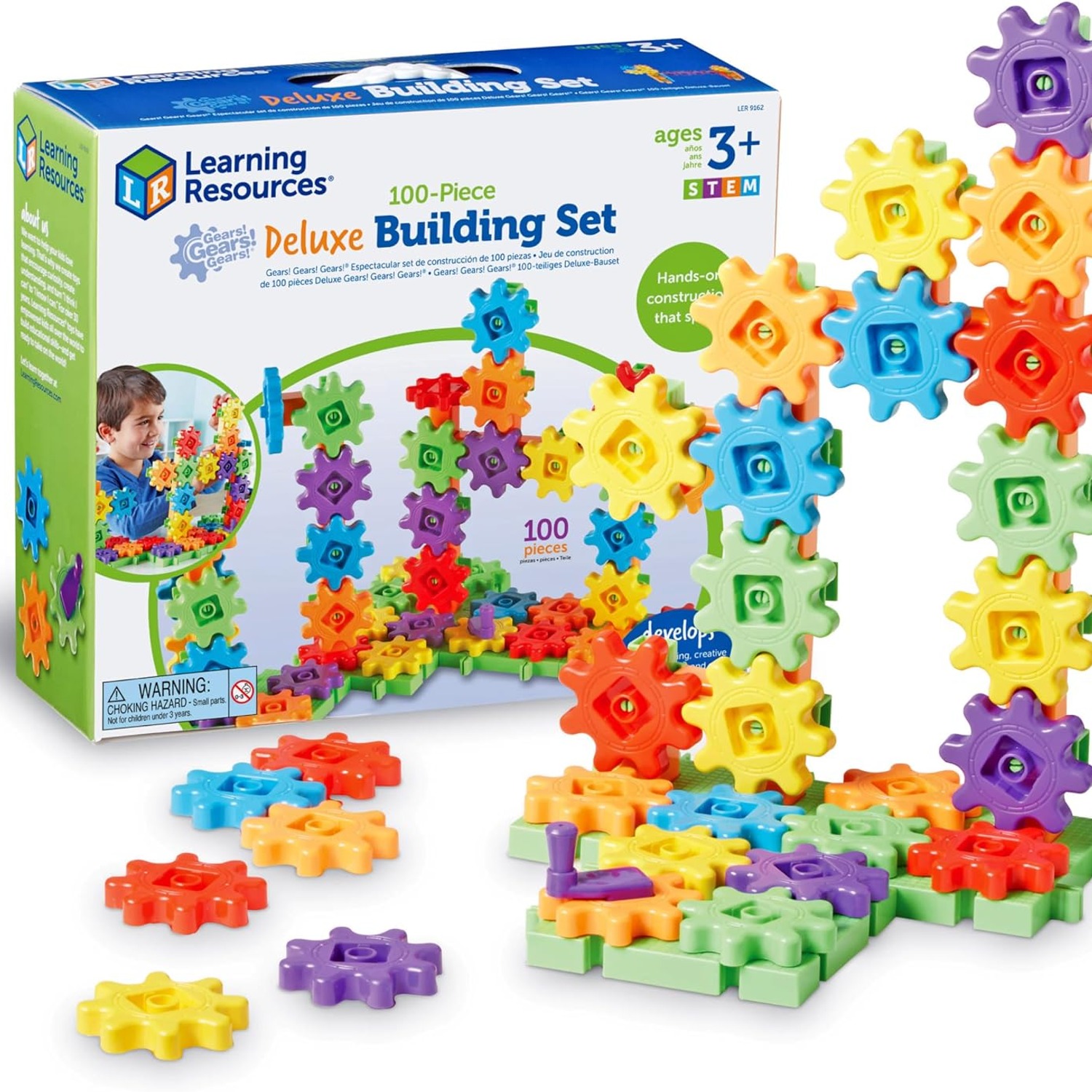
This is a 100-piece set from Learning Resources, model LER9162, sold under the name Gears! Gears! Gears!. Inside the box are 46 gears in blue, green, orange, red and purple, 26 square pillars, 21 six-way axles, 6 interlocking bases, 1 crank handle and an activity guide.
Each part has a job. The bases click together to make a bigger, steadier platform. The axles plug into the bases and give the gears somewhere to sit. The pillars add height, which is how builds go from flat to three dimensional. The crank handle is the input, the thing a child grabs to make everything move at once.
The whole kit weighs about 1 kg and the item dimensions are 30.5 x 26.4 x 10.4 cm. It is light enough for a child to carry and small enough to live on a shelf rather than taking over a room.
How it works, in plain terms
Gear teeth interlock. When one gear turns, its teeth push against the teeth of the gear next to it, which forces that second gear to turn as well. Because the push happens on the outside edge, the second gear spins the opposite way to the first. Add a third and it goes back to the original direction.
Children figure this out without being told. They turn the crank, they watch, and they notice the pattern. Then come the follow-up questions. Why does the small gear go round faster than the big one? What happens if I put a gear where the teeth do not quite reach? Can I make something at the far end move by turning the handle here?
Those questions are the real lesson. You do not need to explain ratios or torque to a preschooler. You just need to leave the parts on the floor and let the trial and error happen. When a build jams, the child learns to look for the cause. When a build finally runs the whole way through, the satisfaction is completely earned.
Who it suits
The manufacturer recommends ages 3 years and up, and that lines up with how the set plays. At three, children mostly enjoy the spinning and the colours, and they need a hand getting gears to mesh. By four or five, most are building independently and starting to plan before they assemble. Older children use it for more ambitious layouts and tend to build faster than adults do.
It is listed as a one-player set, but that is more about how it is counted than how it is used. Two children on the same floor will divide the pieces, build separately and then connect their structures. That negotiation over who gets the red gears is its own kind of learning.
It is a sensible choice if you are hunting for the best preschool construction toy that does not need charging, or a screen-free option that still holds attention. It suits home playrooms, early years classrooms, waiting areas and occupational therapy sessions where hand strength matters.
It is less suited to children under three, because of the small parts, and to anyone who wants a toy with a single defined outcome. There is no finished model pictured on the box that you build once and display forever.
How to choose and what to compare
If you are weighing this up against other options, a few things are worth checking.
Piece count matters, but only to a point. One hundred pieces is enough for substantial builds without overwhelming a small child or a small table. Smaller sets run out of parts fast and frustrate builders who want height.
Power source is the bigger decision. Battery-driven sets spin on their own, which looks impressive for about ten minutes. Manual sets like this one put the child in charge of the speed and direction, and that hands-on control is what makes the cause and effect obvious. No batteries also means no flat cells on a Sunday morning.
Think about storage before you buy. A hundred loose plastic pieces need a home. A clear tub with a lid works best, and sorting by colour on pack-up makes the next session quicker to start.
Finally, consider how long you want the toy to last. Open-ended sets have a much longer useful life than single-outcome toys, and this is one that commonly gets handed down to younger siblings still fully usable.
Looking after it
Plastic construction pieces are forgiving, but a bit of care keeps them working smoothly. Wipe them with a damp cloth and a small amount of mild soap when they get grubby, then dry them properly before they go back in the tub. Trapped moisture in a sealed container is never a good idea.
Keep the pieces out of the dishwasher, the washing machine and any source of real heat. Warped teeth will not mesh, and once a gear is deformed there is no fixing it. Long spells in direct sunlight can also fade the colours over time.
Count the pieces back into the box occasionally. Gears that go missing under sofas are the most common reason a set stops getting used, and a quick sweep around the room usually finds them.
Getting the most out of it
A few small things make a big difference. Start on a hard floor or a table rather than carpet, since bases sit flatter and builds stay steadier. Give the activity guide to the child rather than reading it at them, and let them pick which idea looks interesting.
Ask questions instead of giving instructions. "What do you think happens if you add one more gear here?" works far better than "put that one there". When something does not turn, resist the urge to fix it yourself for the first thirty seconds. That pause is where the learning lives.
Mix it into other play too. Gears can become part of a block city, a pretend factory or a marble run setup. The set does not care what story it is in.
The short version
This is a 100-piece plastic gears building set from Learning Resources, model LER9162, for children aged 3 and up. You get 46 gears in five colours, 26 pillars, 21 six-way axles, 6 bases, a crank handle and an activity guide. It runs entirely by hand with no batteries, it weighs about 1 kg, and the box measures 30.5 x 26.4 x 10.4 cm.
It is a good buy if you want a toy that grows with a child, teaches through doing rather than telling, and comes out of the cupboard more than twice. It is not the right buy for under-threes or for anyone who wants a build-it-once display model.
If you want a hands-on science toy that keeps working for years, this one earns its shelf space.